Skip to content
Skip to content

Structured cabling

Data and structured cabling across County Down and Northern Ireland

Structured Cat6 and Cat6a data cabling, patch panels and comms cabinet builds designed so the next piece of work is straightforward instead of a puzzle.

Who structured cabling is for

Offices, pubs, hotels, retail units, visitor attractions, workshops and homes that need reliable wired connections — for access points, cameras, tills, desks, TVs or home offices. It suits fit-outs, refurbishments and any site where nobody can say what plugs in where.

Problems this solves

The commercial cost of getting this wrong.

These are the day-to-day symptoms JKL Electrix hears about most from businesses across Northern Ireland — buying more equipment rarely fixes them on its own.

  • Old, undocumented cabling nobody wants to touch
  • Loose patch leads and unlabelled panels in the comms cabinet
  • Access points powered from wall sockets instead of PoE
  • Cabling that fails to hit spec on certification
  • Fit-outs where cabling was left to whoever turned up
  • No clear path to add ports without more disruption

Survey and diagnosis

How the property is assessed first.

  1. 1Walk the building and agree the outlet positions with the people who actually use the rooms.
  2. 2Inspect existing containment, trunking and risers to see what can carry new runs without damage to the building.
  3. 3Check the existing cabinet or comms point for space, power and ventilation.
  4. 4Test any existing cabling that could be reused, rather than assuming it is scrap.
  5. 5Issue a written schedule of runs, outlets and cabinet work before starting.

What's included

Practical, right-sized structured cabling.

  • Cat6 or Cat6a cabling to modern spec
  • Patch panels, faceplates and modules from consistent brands
  • Comms cabinet design, tidy and correctly earthed
  • PoE-ready runs for access points and cameras
  • Full labelling and end-of-job documentation
  • Testing on installation

Testing, labelling and handover

  • Every terminated cable tested before sign-off — as photographed on the Castlewellan install.
  • Both ends of every run labelled to match the patch panel.
  • Port-by-port map so the site knows exactly what plugs in where.
  • Cabinet photographed and documented on completion.

Service area: Downpatrick, Newcastle, Castlewellan, Crossgar, Ballynahinch and across County Down, plus commercial work throughout Northern Ireland.

Related project

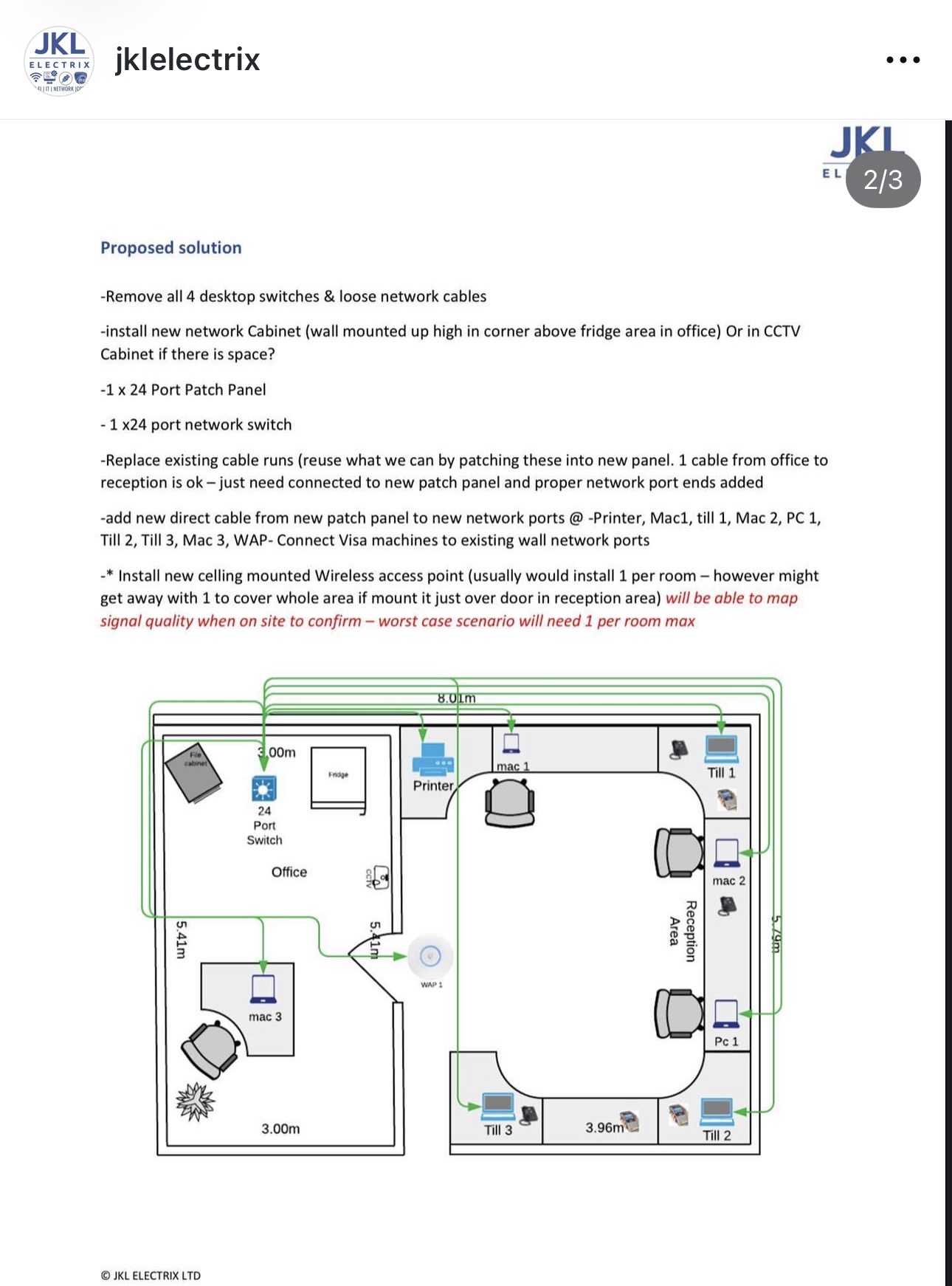
JKL Electrix proposed network solution drawing for Saint Patrick Centre

Public venue · Downpatrick, Co. Down

Saint Patrick Centre, Downpatrick — from 7.5 Mbps to full-line 75 Mbps

A visitor centre whose backbone had been built on consumer home-plug adapters, throttling the whole building to around 7.5 Mbps.

Read the Downpatrick case study

Structured Cabling — common questions

Cat6 or Cat6a — which do we need?
Cat6 handles gigabit comfortably and suits most access-point, camera and desk runs. Cat6a is worth specifying for longer runs or where 10-gigabit links between cabinets and switches are likely. The choice is made per run, not per building.
Can you replace home-plug adapters with proper cabling?
Yes, and it is one of the most common jobs. At the Saint Patrick Centre a home-plug backbone was holding a 75 Mbps line down to about 7.5 Mbps; replacing it with structured cabling restored full line speed.
Is the cabling tested?
Every terminated cable is tested with a certified cable tester before sign-off, and the results are part of the handover.
How much disruption is there?
Existing containment, voids and risers are used wherever possible so fewer surfaces are disturbed. Any making good needed is agreed in advance rather than discovered afterwards.
Do you cable for CCTV as well as Wi-Fi?
Yes — PoE runs to camera positions are specified the same way as access-point runs, so cameras are powered and networked from one cable.
Related pages

Not sure what your business needs?

Start with a Business Network Assessment — a paid, on-site review that gives you clear findings and a fixed-price quotation.

The full £199 fee is credited against qualifying installation work of £1,500 or more.